


Switches | Outlets | Troubleshooting | LED Tube Lights | Basic Electricity | Ballasts | Replace Ballasts | Misc Articles
Electrical Meters and Testers Info and Examples
Voltage Detectors
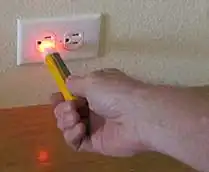
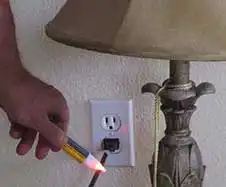
A voltage detector is made of plastic, so there is no direct contact with a circuit. This tester will indicate when voltage is present by sensing a magnetic field generated by a voltage. A voltage detector tests outlets, cords, light sockets (results may vary), switches, and ballasts. This tester will only test for voltage on the line part of an outlet or cord (not neutral or ground). Always use a voltage detector on a known good circuit before use to verify the detector is working properly. Place the tip inside the line side of an outlet to see if power is on. Place the tip inside incandescent sockets and near fluorescent light sockets for presence of power (results may vary).Always use a voltage detector on a known good circuit before use to verify the detector is working properly. Find Voltage Detectors
Outlet Testers
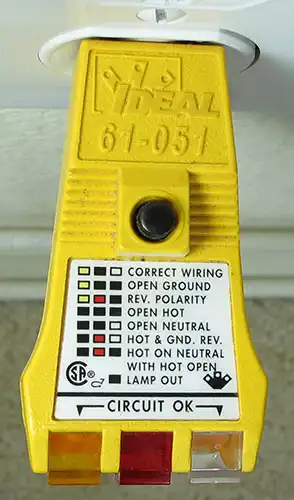
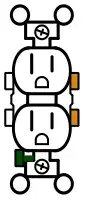
For testing outlets including GFCIs and AFCIs, a test may be done to determine if power is present or if an outlet is wired properly. It will show the status of the line, neutral, and ground. This tester does not have a battery. The light pattern that indicates circuit condition can vary with different brands of testers. Find Outlet Testers
GFCI test button (optional).
Pressing this button will trip a normally functioning GFCI and cut power to any outlet that is connected to the load side of that GFCI. The GFCI test button will not work with old house wiring that does not have ground wires.
There are a variety of meters and testers available for testing electrical and electronic circuits. Test measurements include voltage, current, ohms, and continuity.
Light and/or beep indicates voltage used on line side of outlet only (not neutral or ground)
Detect if voltage is present on an electrical cord
Clamp Meters
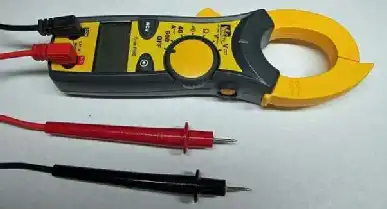
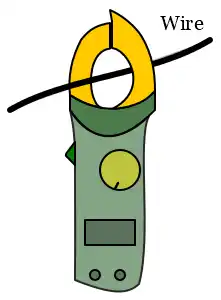
Clamp meters are usually multimeters that “clamp” around a wire to measure current (amps). A clamp meter can commonly measure up to 600 amps. A clamp meter can measure both AC and DC current. This meter can be used to measure the alternator current of your vehicle by clamping to a battery cable. Find Clamp Meters
Solenoid Voltage Testers
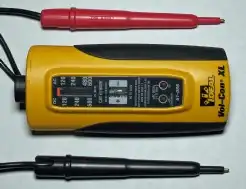
Test outlets, lamp sockets, electrical panels, fuses, and switches. This tester has a low input impedance and places a small load on a circuit. It will not give precise voltage, but is a quick way to show if voltage is present. This tester can be used for certain photocells, dimmer switches, a poor connection, or parallel wires where voltage may be present, but not be able to operate a load. Certain models contain a battery for continuity tests. See “solenoid tester warning” in the safety instructions above before using this tester. Find Solenoid Voltage Testers
A night light or hair dryer can test outlets for the presence of voltage. A night light can be used to see if line and neutral are present in an outlet. A hair dryer can be used to test if a circuit could handle a very high current. If a nightlight works on an outlet, but a hair dryer does not, there could be a loose connection or a bad outlet or GFCI.
Meter and Tester Safety
CAUTION! Before using any type of electrical meter or tester, follow these safety instructions. Not doing so may lead you to think the power is off when it is actually on, or give you a false measurement.
- Avoid buying a cheap meter or tester. Go with major brands including Fluke, IDEAL, Klein, Greenlee, Amprobe, Sperry, Extech, Milwaukee, Gardner Bender, and Southwire.
- Always read and understand meter and tester instructions. Multimeters usually have different test lead connections for different measurement functions. Do not exceed the maximum voltage rating of meters and testers. Make sure the meter is set for the proper measurement setting (ohms, DC or AC voltage, resistance, etc), otherwise the meter can give an incorrect measurement.
- Most meters and testers contain batteries which must be good to get accurate measurements.
- Check to see if the meter or tester contains fuses, and ensure they are the proper current rating and not blown.
- Meters, testers, and test leads must not have any damage. If test lead insulation is damaged, do not put electrical tape over the damaged leads, they must be replaced.
- Since solenoid testers draw current from the load, this tester must only be connected to power for a very short time (get the voltage reading and disconnect right away). The solenoid tester manual will show how long it can safely be connected to power.
- Always test on a known good circuit before use.
Select image to enlarge

Fluke VoltAlert
Multimeters
Multimeters provides a measurement of volts (E), amps (I) and ohms (Ω). A multimeter can test outlets, light sockets, electrical panels, fuses, and switches. A battery is used for continuity tests. Even though a multimeter measures current (I), the measurement is limited to a fraction of an amp. Find Multimeters
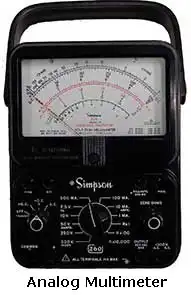
The older analog multimeter uses an indicator that moves over a printed range of E, I, and Ω. You can select maximum ranges of measurement on the meter depending on different ranges of E, I, and Ω that are going to be measured. One selector determines the type of measurement, while another selector determines maximum range. If measuring DC voltage, the red lead must be connected to the positive polarity of the voltage source, and the black lead to the negative.
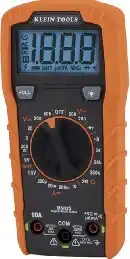
A digital multimeter (DMM) provides a very precise measurement of E, I, and Ω, and has a digital display. This tester has a high input impedance which means you can measure low voltage on logic circuits. Some DMMs will have maximum ranges of measurement settings, others do not.
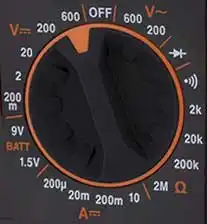
Klein Multimeter Function Selector
About Privacy Policy Question? Copyright © 2026 Electrical101.com Terms of Use
